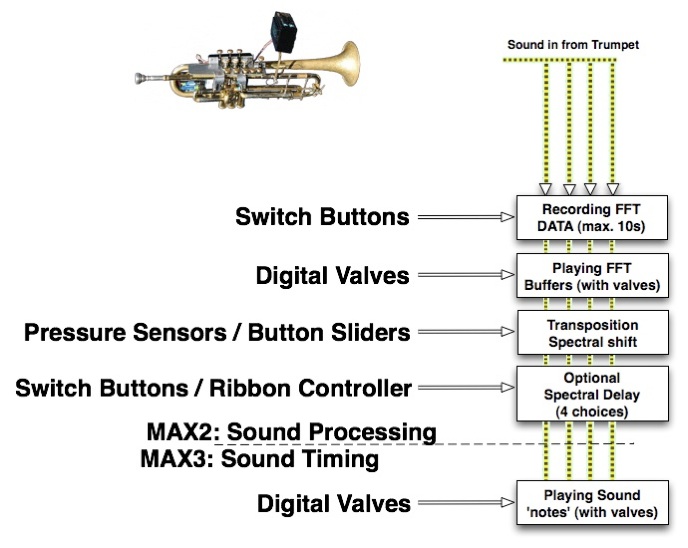










Instance 2: Sound processing
Aesthetically I’d like to use the Electrumpet as a real hybrid instrument. I also like it to react more as an instrument than as a controller. For me that also means using live (trumpet)sounds as input and it means a distinction between direct control (what you see is what you get) and other manipulations.
So for me there are actually two things that I want to control. The sound itself and the timing of that sound. The sound itself is manipulated in two ways:
1) Timed manipulation of the current sound. Those will not be addressed in Instance 2. With this I mean direct manipulation of the incoming (trumpet)sound. Think of octavers, distortion, echo, delay.
2) Buffering, analysis and playback of processed sound. You could think of the filling of buffers with sound. FFT techniques on that sound, convolution, etcetera. Because I like high resolution in my sounds I use large vector sizes. In order to maximize the efficiency in this instance I use low scheduler rates (high scheduler rates would not make any difference anyway).
In the example the (trumpet) sound is buffered as spectral information in four buffers and processed with spectral delay techniques, spectral shifts and transpositions. The place in the buffer can be controlled with the valves.